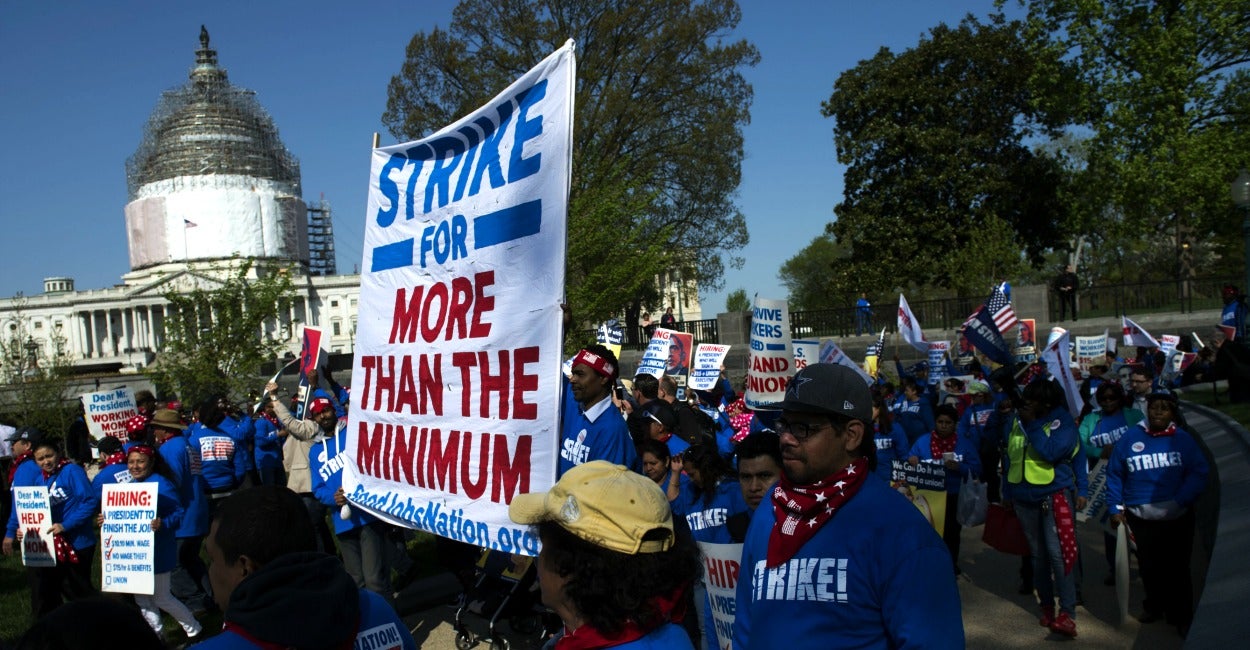
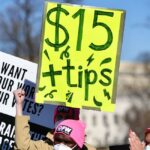
Last summer, the District of Columbia increased its minimum wage to $10.50 an hour, which is currently the highest for any U.S. state or territory. This July, the District’s minimum wage will rise again to $11.50 an hour. Then, on Nov. 8, 2016 D.C. voters may consider an initiative to increase the minimum wage to $15 an hour by 2020, resulting in even more job losses, while business owners and consumers face higher prices.
Why do policymakers think such a high minimum wage may be appropriate? A recent article by the Brookings Institution points out:
The push for $15 per hour in D.C. and elsewhere hasn’t been based on complex statistical analysis. It started with a series of strikes by fast-food workers in 2012, who rallied around $15 as an audacious goal, but one that was round and easy to remember.
While raising the minimum wage sounds compassionate, it will probably hurt the very workers its advocates want to help.
Economists at the University of California-San Diego examined how the 2007-2009 federal minimum wage hike affected low-income workers. They found that it reduced their total earnings by $150 a month. Employers responded to the higher pay by hiring fewer workers, cutting hours, and replacing less skilled workers with more skilled applicants. On net, affected workers lost money.
A recent poll of D.C. business owners found more than half of them plan to eliminate jobs if the minimum wage rises to $15.
TRENDING ARTICLES
Such job losses will probably happen in D.C. as well. A recent poll of D.C. business owners found more than half of them plan to eliminate jobs if the minimum wage rises to $15. In fact, this may already be happening.
The American Enterprise Institute’s Mark Perry examined restaurant employment in the greater D.C. area excluding D.C., and in the District itself. From 2014 to 2015, suburban D.C. area has created 8,900 more jobs (5.3 percent more) in the sector, while restaurant employment in D.C. added only a few hundred jobs (less than 0.5 percent growth).
These changes will also hurt low- and middle-income consumers. When business costs rise, firms must raise prices. In order to afford $15 an hour, the average fast food restaurant would have to reduce employee hours by a third while increasing prices 38 percent.
Advocates want minimum wage increases to help low-income workers. Instead, they will make it more difficult for workers to find work while raising their cost of living.
Read the first chapter of The Woketopus right now for FREE
Today, even with President Trump’s victory, leftist elites have their tentacles in every aspect of our government.
The Daily Signal’s own Tyler O’Neil exposes this leftist cabal in his new book, The Woketopus: The Dark Money Cabal Manipulating the Federal Government.
In this book, O’Neil reveals how the Left’s NGO apparatus pursues its woke agenda, maneuvering like an octopus by circumventing Congress and entrenching its interests in the federal government.
You can read the first chapter of this new book for FREE in this eBook, The Woketopus: Chapter One using the secure link below.

TRENDING ARTICLES

The Daily Signal depends on the support of readers like you.
RELATED ARTICLES



Don’t miss the

Don’t miss the signal