
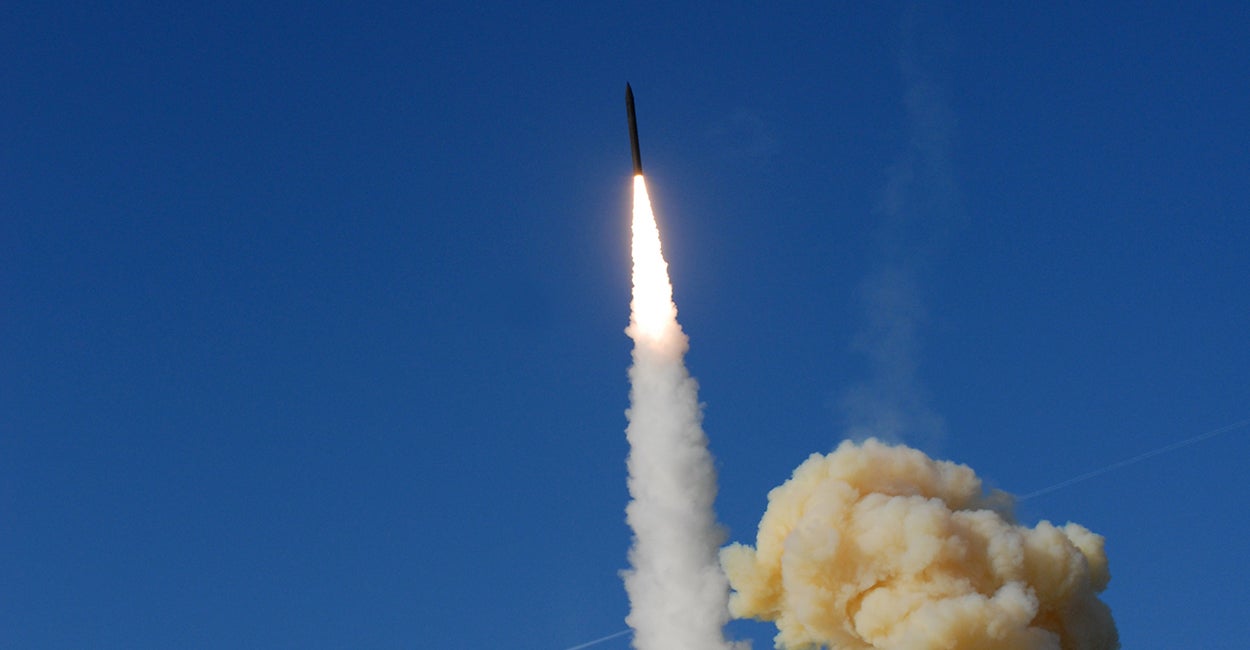
On Sunday, the U.S. Ground-Based Midcourse Defense (GMD) successfully intercepted a sophisticated long-range ballistic missile target. The target involved counter-measures. Counter-measures can be decoys or dummy warheads design to complicate missile defense tracking and overwhelm the interceptor so that it misses its target or hits a wrong warhead. This was a first successful GMD intercept since 2008.
Why does this matter?
Sunday’s accomplishment is a positive development toward making the GMD, the only system currently protecting the U.S. from a long-range ballistic missile threat, more reliable and effective.
The test proved that U.S. engineers and scientists learn from failures and can make the system works when given a chance. A continued robust testing program is an imperative for developing an effective layered ballistic missile defense system.
“This is a very important step in our continuing efforts to improve and increase the reliability of our homeland ballistic missile defense system,” said MDA Director Vice Admiral James Syring.
Why is it important that we have a defense against long-range ballistic missiles? What countries could use them against us?
TRENDING ARTICLES
U.S. adversaries like Iran or North Korea are developing ballistic missiles to threaten the U.S., its forward deployed forces, and allies. After all, a long-range ballistic missile takes only about 33 minutes to reach U.S. homeland from anywhere in the world. A successful ballistic missile attack could cause incredible destruction. If the U.S. and allies remain vulnerable, adversaries can also ballistic missile threats to coerce the U.S. or allies and limit their freedom of action in responding to policies that are damaging to U.S. interests. China and Russia maintain hundreds of long-range ballistic missiles. The current U.S. missile defense system is not capable of dealing with their ballistic missiles should their intentions become more adversarial.
What is the political situation regarding long-range missile defense?
The Obama administration decided to deploy 14 additional interceptors to protect U.S. homeland last year.
As House Armed Services Committee chairman Howard P. “Buck” McKeon (R-CA) noted, “[I]t is well-past time for the Administration to end its five year assault on the missile defense budget and its programs. We must build on this recent success to defend the U.S. and its allies from a growing threat.”
What should the United States do going forward?
Sunday’s intercept proves engineers and scientists have learned from the system’s previous failures and corrected them. A robust testing program would provide additional opportunities to advance and improve the system. A rigorous and frequent testing program would greatly aid the development of all future GMD components, such as an advanced version of the kill vehicle.
The U.S. must meticulously test and fine-tune its GMD system and recognize that there will be failures along the way, especially given how complex the system is. The U.S. must protect its citizens from long-range ballistic missile attacks, regardless of the origin of such an attack.
After all, to provide for common defense is one of the primary obligations of the federal government.

Read the first chapter of The Woketopus right now for FREE
Today, even with President Trump’s victory, leftist elites have their tentacles in every aspect of our government.
The Daily Signal’s own Tyler O’Neil exposes this leftist cabal in his new book, The Woketopus: The Dark Money Cabal Manipulating the Federal Government.
In this book, O’Neil reveals how the Left’s NGO apparatus pursues its woke agenda, maneuvering like an octopus by circumventing Congress and entrenching its interests in the federal government.
You can read the first chapter of this new book for FREE in this eBook, The Woketopus: Chapter One using the secure link below.

TRENDING ARTICLES

The Daily Signal depends on the support of readers like you.
RELATED ARTICLES




Don’t miss the

Don’t miss the signal